# dpss
离散长椭球体(Slepian)序列
函数库: TySignalProcessing
# 语法
dps_seq = dpss(seq_length,time_halfbandwidth)
dps_seq = dpss(seq_length,time_halfbandwidth,num_seq)
dps_seq,lambda = dpss(seq_length,time_halfbandwidth)
dps_seq,lambda = dpss(seq_length,time_halfbandwidth,num_seq)
# 说明
dps_seq序列) = dpss(seq_length,time_halfbandwidth) 返回第一个长度为 round(2*time_halfbandwidth) 的离散长椭球体 (DPSS) 序列或长度为 seq_length 的 Slepian 序列。dps_seq 是具有 seq_length 行和 round(2\*time\_halfbandwidth) 列的矩阵。time_halfbandwidth 必须严格小于 seq_length/2。
dps_seq序列) = dpss(seq_length,time_halfbandwidth,num_seq) 返回第一个长度为 round(2\*time\_halfbandwidth) 的离散长椭球体 (DPSS) 序列或长度为 seq_length 的 Slepian 序列。dps_seq 是具有 seq_length 行和 round(2\*time\_halfbandwidth) 列的矩阵。time_halfbandwidth 必须严格小于 seq_length/2,num_seq 用于指定序列长度。lambda 是长度等于 Slepian 序列数量的列向量。
dps_seq序列),lambda = dpss(seq_length,time_halfbandwidth) 返回 dps_seq 中列向量的频域能量集中比。这些比率表示通带中的能量量 [–W,W] 与 [–Fs/2,Fs/2] 的总能量,其中 Fs 是采样率。lambda 是长度等于 Slepian 序列数量的列向量。
dps_seq序列),lambda = dpss(seq_length,time_halfbandwidth,num_seq)返回第一个 num_seq Slepian 序列,其时间半带宽乘积 time_halfbandwidth 由其能量集中率排序。如果 num_seq 是一个双元素向量,则返回的 Slepian 序列的范围为 num_ seq(1) 到 num 单元 seq(2)。
# 示例
生成长椭球体 (Slepian) 序列
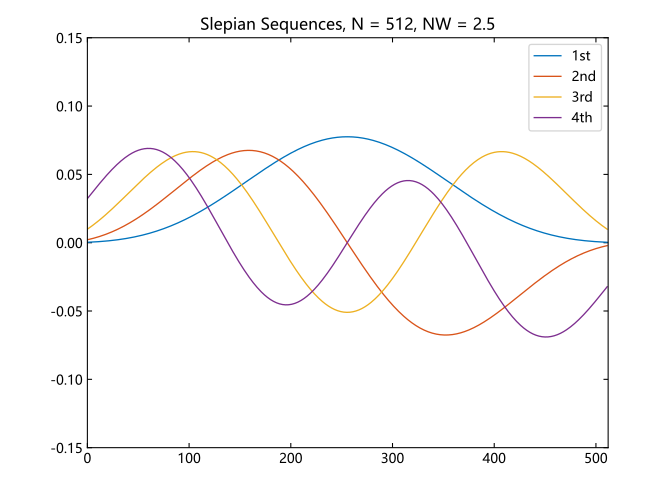
构造长度为 512 的前 4 个离散长球体序列。指定半带宽时间积为 2.5,绘制序列。
using TyPlot
using TySignalProcessing
seq_length = 512
time_halfbandwidth = 2.5
num_seq = Int(2 * (2.5) - 1)
dps_seq, lambda = dpss(seq_length, time_halfbandwidth, num_seq)
plot(dps_seq)
title("Slepian Sequences, N = 512, NW = 2.5")
axis([0 512 -0.15 0.15])
legend(["1st", "2nd", "3rd", "4th"])
concentration_ratios = lambda'
concentration_ratios = 1×4 adjoint(::Vector{Float64}) with eltype Float64:
 0.999997  0.999843  0.996216  0.952129
# 输入参数
seq_length - 序列长度正整数
序列长度。
数据类型: Int
复数支持: 否
time_halfbandwidth - 半带宽时间标量
半带宽时间。
数据类型: Int | Float
复数支持: 否
num_seq - 输出序列长度正整数
输出序列长度。
数据类型: Int
复数支持: 否
# 输出参数
dps_seq - 离散长椭球体 (Slepian) 序列矩阵
离散长椭球体 (Slepian) 序列。
数据类型: Float
复数支持: 否
lambda - 长度向量
lambda 是长度等于 Slepian 序列数量的列向量。
数据类型: Float
# 更多
离散长椭球序列
离散长椭球序列或 Slepian 序列源自以下时频集中问题。对于所有有限能量序列,x[n] 指数仅限于某个集合
其中Fs是采样率
时间半带宽积
时间半带宽乘积为 NW,其中N是序列的长度,[-W,W] 是序列的有效带宽。在构造 Slepian 序列时,选择所需的序列长度和带宽 2W。序列长度和带宽都会影响有多少 Slepian 序列的浓度比接近 1。通常,有 2NW – 1 个 Slepian 序列的能量集中比近似等于 1。超过 2NW – 1 个 Slepian 序列后,浓度比开始接近零。时间半带宽乘积的常见选择有:2.5、3、3.5 和 4。
通过将时间半带宽乘积定义为 NW/Fs,可以指定 Slepian 序列的带宽(单位为 Hz),其中 Fs 是采样率。